Pearson Edexcel · GCSE · Psychology
Course version: 1PS0 · Version from Sept 2017
Understand ethical issues in psychological research and how to deal with…
Full specification wording
Designing psychological research: 11.1.8 Understand ethical issues in psychological research and how to deal with ethical issues, including: a. informed consent b. deception c. confidentiality d. right to withdraw e. protection of participants
Ethical guidelines protect participants in psychological research.
Checked against the Pearson Edexcel 1PS0 specification (opens in a new tab) on .
- Point 8 of 17
Study notes
From the checked teaching notes for this specification point.
The idea
Ethical guidelines protect participants in psychological research. Informed consent requires researchers to explain the study's aims and procedures so participants can agree to take part. If deception is necessary to prevent demand characteristics, researchers must deal with this by providing a full debrief afterwards. Confidentiality ensures participants' data is kept anonymous and secure. The right to withdraw means participants can leave the study at any time and have their data destroyed. Protection of participants ensures they are not exposed to physical or psychological harm greater than in everyday life. Researchers deal with these issues by using consent forms, debriefing, anonymising data, and conducting risk assessments.
What earns the marks
- Identify the ethical issue breached in a given scenario, such as a lack of informed consent.
- Explain how a researcher can deal with deception by using a comprehensive debrief.
- Describe how confidentiality is maintained by using participant numbers instead of names.
- Evaluate the balance between the need for deception and the protection of participants from psychological harm.
Common mistakes and how to put them right
Confusing anonymity with confidentiality.
Put it right: Anonymity means the researcher does not know the participant's identity, whereas confidentiality means the researcher knows it but keeps it secure and unpublished.
Believing participants cannot be deceived under any circumstances.
Put it right: Deception can be used if justified and if participants are fully debriefed afterwards.
Thinking the right to withdraw only applies before the study begins.
Put it right: Participants have the right to withdraw before, during, and after the study, including withdrawing their data.
Exam tips
- When evaluating a study, explicitly state which ethical guideline was broken and provide evidence from the scenario.
- Always link the method of dealing with an ethical issue back to the specific problem, such as using a debrief to resolve deception.
- Remember that protecting participants includes preventing both physical injury and psychological distress, such as embarrassment or anxiety.
Try the lesson
The start of the Designing psychological research: 11.1.8 Understand ethical issues in psychological research and how to deal with ethical issues, including: a. informed consent b. deception c. confidentiality d. right to withdraw e. protection of participants lesson, made from checked teaching notes for this specification point.
Have a go first
Which of the following best describes the ethical issue of deception in psychological research?
Listen
Ethical guidelines protect participants in psychological research. Informed consent requires researchers to explain the study's aims and procedures so participants can agree to take part. If deception is necessary to prevent demand characteristics, researchers must deal with this by providing a full debrief afterwards. Confidentiality ensures participants' data is kept anonymous and secure. The right to withdraw means participants can leave the study at any time and have their data destroyed. Protection of participants ensures they are not exposed to physical or psychological harm greater than in everyday life. Researchers deal with these issues by using consent forms, debriefing, anonymising data, and conducting risk assessments. A strong answer earns marks for these points. Identify the ethical issue breached in a given scenario, such as a lack of informed consent. Explain how a researcher can deal with deception by using a comprehensive debrief. Describe how confidentiality is maintained by using participant numbers instead of names. Evaluate the balance between the need for deception and the protection of participants from psychological harm. Exam tip: When evaluating a study, explicitly state which ethical guideline was broken and provide evidence from the scenario.
See it
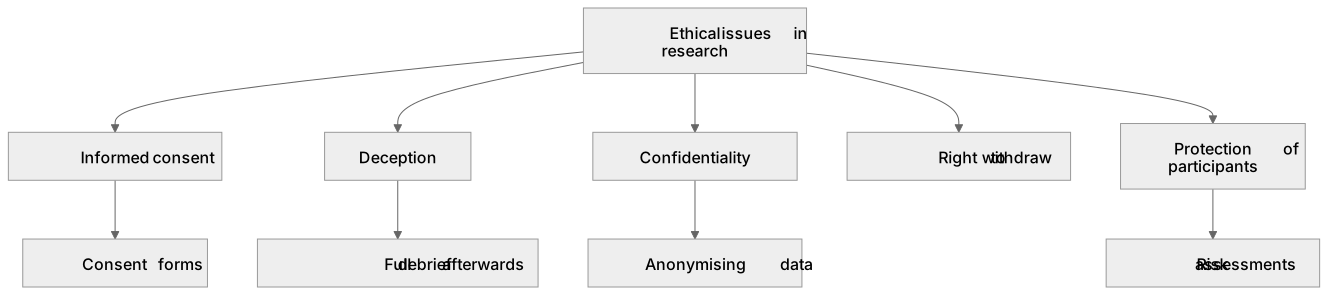
Label the diagram
Some boxes have lost their names. Pick the right name for each number.
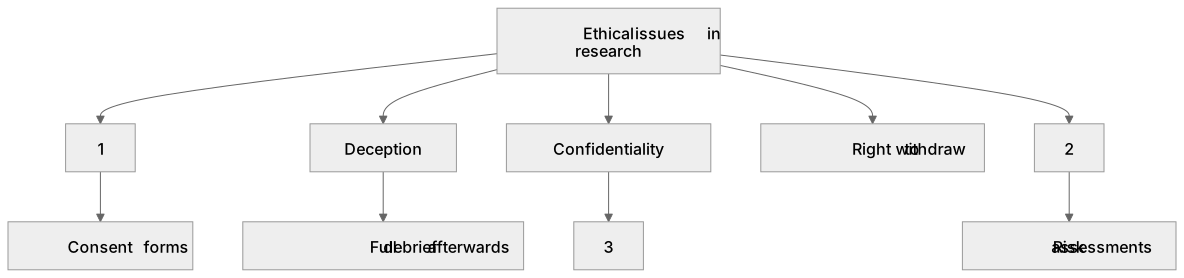
1Box 1
2Box 2
3Box 3
There is more to this lesson
The full lesson goes on to check your understanding and help you earn the marks. Create a free account to carry on, with your progress saved.
A week of Premium from your first lesson · Then the free plan continues · No card, no charge
Test your understanding of Designing psychological research: 11.1.8 Understand ethical issues in psychological research and how to deal with ethical issues, including: a. informed consent b. deception c. confidentiality d. right to withdraw e. protection of participants
Active recall beats re-reading. Take an instant quiz now to test what you’ve learned and lock it into long-term memory.
A week of Premium from your first lesson · Then the free plan continues · No card, no charge